What is Ashmere?
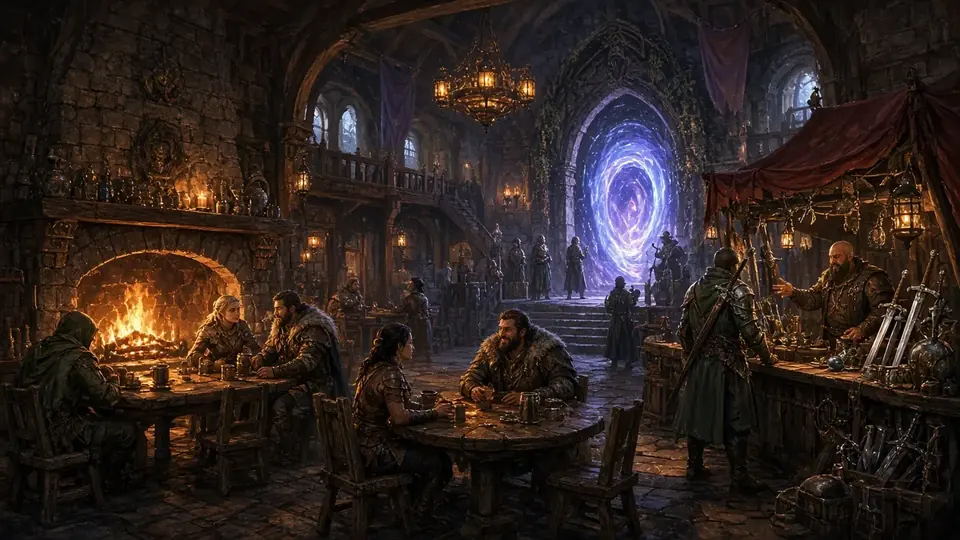
Ashmere is a free, single-player role-playing game that runs entirely in your web browser. It is built to feel like a tabletop Dungeons & Dragons session where you are the only player at the table. A computer Dungeon Master, called the Keeper, describes each scene, offers you choices, and asks you to roll a twenty-sided die when the outcome is uncertain. There is nothing to download and no account to create. You pick a class, enter the town of Ashmere, and step through a hearth-portal into the first of eight wounded realms.
The game is designed to be finished. A realm is a run of nine rooms, a mix of story scenes, traps, bargains, puzzles and fights that ends with a boss. Between runs you return to the Gilded Lantern, the tavern that serves as your hub, where you shop, rest, temper gear and pick up side work.
How a chronicle works
Each saved game is called a chronicle, and you have three slots. You begin by choosing a name and a class, then set your six ability scores. You can roll four six-sided dice and drop the lowest for each score, the classic tabletop method, and swap scores to suit your build, or take the class's recommended array. You also choose a difficulty and whether the chronicle is hardcore.
Once you are in, play follows a simple loop:
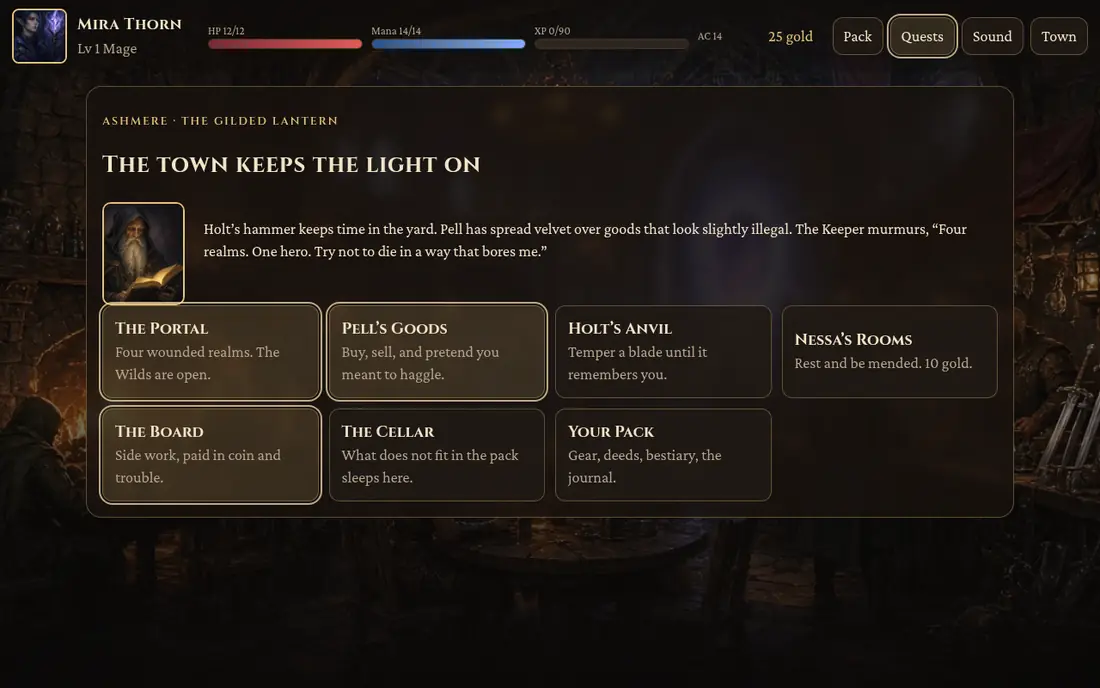
- Prepare in the Gilded Lantern. Spend gold at Pell's shop, rest at Nessa's rooms, temper a weapon at Holt's anvil, read the quest board, and stash spare items in the cellar.
- Open the portal. Choose a realm. Each card shows a recommended level range and an expected playtime, for example “Lv 1–4 · ~20–40 min”. Only the Whispering Wilds is open at first. Beating a realm's master unlocks the next one.
- Work through the realm. The first four realms are nine rooms; the later four are thirteen. The Keeper describes each scene and gives you two to four choices. Many choices are skill checks: you roll a d20, add the matching ability modifier and your proficiency bonus, and try to beat a difficulty number that is shown on the button before you commit.
- Fight when you must. Combat is turn-based. Initiative is a d20 plus Dexterity. You attack, use a class technique, drink a potion, or try to flee, and the game shows every roll so you can see exactly why something hit or missed.
- Take your spoils home. Gold, experience and items are yours to keep, even if you retreat through the portal early. Your level, gear and gold persist from run to run.
Four classes

Each class plays differently, and each has eight techniques, two at the start and a choice of one from each pair at levels 3, 5 and 7.
| Class | Playstyle | Base HP | Resource | Starting weapon | Starting armor | Recommended scores |
|---|---|---|---|---|---|---|
| Warrior | Melee bruiser. Stamina fuels heavy blows and a second wind. | 14 (+7/level) | Stamina | Longsword (1d8, STR) | Chain Shirt (AC +4) | STR 15, DEX 13, CON 14, INT 8, WIS 12, CHA 10 |
| Mage | Glass and lightning. Mana spends into bolts, frost, and fire. | 11 (+5/level) | Mana | Oak Staff (1d6, INT) | Travel Robes (AC +2) | STR 8, DEX 14, CON 13, INT 15, WIS 12, CHA 10 |
| Rogue | Precision and poison. Win initiative and the math gets kinder. | 11 (+6/level) | Stamina | Twin Daggers (1d6, DEX) | Leather Jack (AC +2) | STR 8, DEX 15, CON 13, INT 10, WIS 12, CHA 14 |
| Cleric | Radiance and mending. Wisdom guides the hammer and the heal. | 11 (+6/level) | Mana | Warhammer (1d8, WIS) | Chain Shirt (AC +4) | STR 13, DEX 10, CON 14, INT 8, WIS 15, CHA 12 |
- Warrior: the durable melee fighter, with Power Strike, the self-heal Second Wind and the best HP growth.
- Mage: the glass cannon, with Arcane Bolt, Frostbind, Chain Lightning and the late-game Meteor.
- Rogue: rewards winning initiative, with Backstab, poison and guaranteed critical hits.
- Cleric: healing and radiant damage, with Sacred Flame especially strong against undead.
You can read a full build guide for each: Warrior, Mage, Rogue and Cleric.
Eight realms and eight bosses
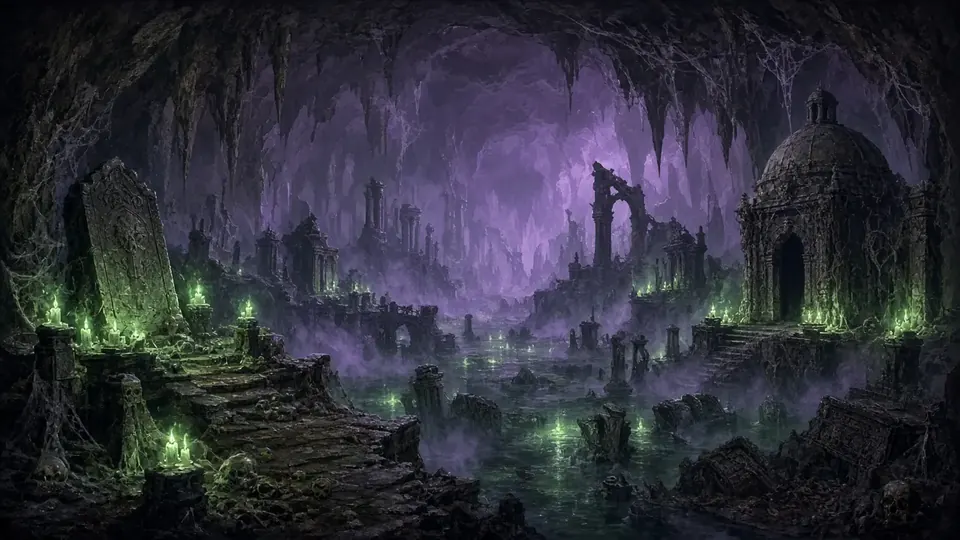
The realms unlock in order and are tuned for a rising level range. The portal lists the recommended levels and expected playtime on each card. On the Board, every mission also shows a recommended level, coloured green, amber or red against your current level so you can tell at a glance if it will be hard.
| Realm | Suggested levels | Playtime | Master |
|---|---|---|---|
| The Whispering Wilds | 1–4 | ~20–40 min | Ormroot, the Corrupted Treant Elder |
| The Sunken Crypts | 4–7 | ~20–40 min | Lich King Malrec |
| Frostfang Peaks | 7–10 | ~20–40 min | Korr the Unthawed |
| Emberforge Wastes | 10–13 | ~20–40 min | Vexithra the Unbanked |
| The Salt Oratory | 13–16 | ~35–65 min | Abbess Vellum |
| The Thorn Bazaar | 16–19 | ~35–65 min | The Ledger Moth |
| The Clockfall Stairs | 19–22 | ~35–65 min | The Hourwright |
| The Quiet Crown | 22–24 | ~35–65 min | The Oathking |
The first four realms are nine-room runs. The later four are a little longer: thirteen rooms, with more fights and a full arc that still ends in a phased boss. Every realm has its own monsters, traps, bargains, riddles and a side quest or two. Bosses fight in phases: they summon allies when they are wounded, grow more dangerous below a third of their health, and unlock stronger attacks late in the fight. Our walkthroughs cover the first four in detail: Whispering Wilds, Sunken Crypts, Frostfang Peaks and Emberforge Wastes. The later four are summarised in Ashmere's later realms.
Loot that persists
Gear drops from fights and from some rooms, and it comes in five rarities: common, uncommon, rare, epic and legendary. Higher rarities carry more affixes, such as "of the Bear" (+1 Strength), "of Vitality" (+4 max HP), "of Warding" (+1 armor class) or "of Precision" (a wider critical range). You can equip one weapon, one armor, one amulet and one ring, carry sixteen items in your pack and store thirty-two more in the cellar. Holt the smith can temper a piece of gear up to three times. The loot and affixes guide explains the numbers.
Leveling and respec
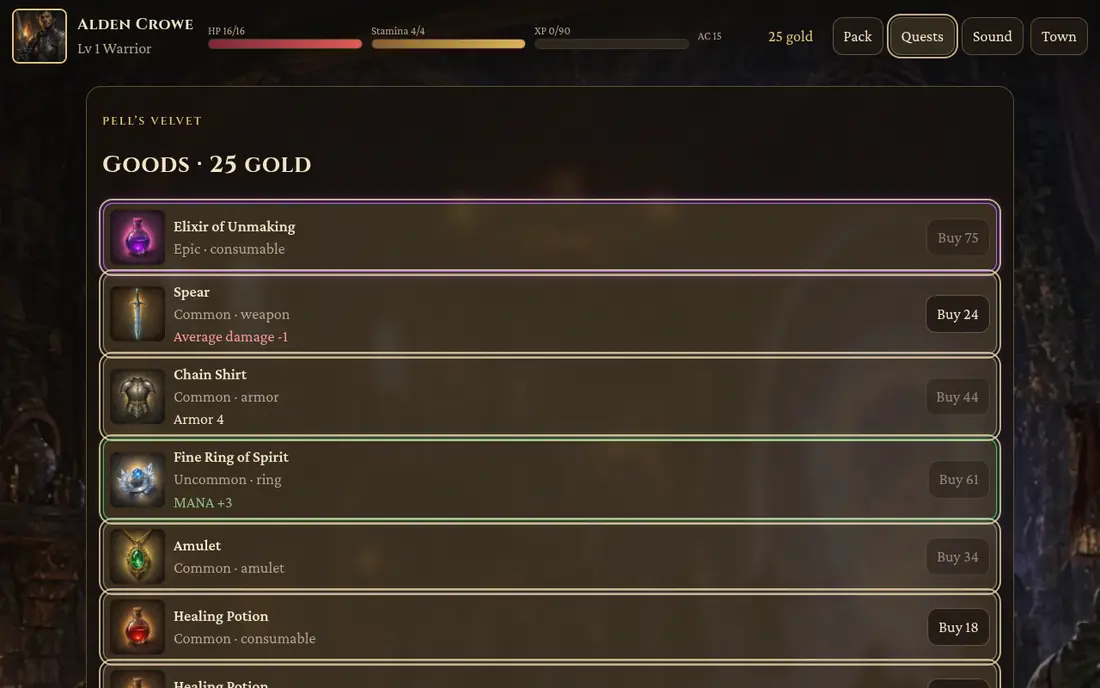
You can reach level 24. Each level gives one ability point to spend, and levels 3, 5 and 7 let you learn a new technique. Spending a point asks you to confirm the choice. If you change your mind later, Pell always stocks the Elixir of Unmaking. It costs 50 gold plus 25 gold per level, and it refunds every point and technique you chose after character creation so you can rebuild. See the leveling, stats and respec guide.
Difficulty, hardcore and deeds
Pick Story, Normal or Deadly when you create a chronicle. Story softens enemy health and damage and eases skill-check difficulties. Deadly does the reverse and hits harder, but improves your loot odds. You can also tick the Hardcore box: if you fall, the book closes for good and there is no road home. Outside hardcore, falling returns you to Ashmere with 30 percent of your gold lost. There are twenty-five deeds (achievements) to unlock, a bestiary that records every foe you meet, and a journal of your recent pages. Our hardcore guide covers survival tips.
Controls and saving
- Mouse or touch: every choice, technique and menu is a button.
- Number keys 1–9: pick the matching scene choice.
- Enter / Escape: confirm or cancel pop-ups. Sound can be toggled in the top bar.
- Saving: the game saves into your browser's local storage as you play. There are three slots. Use Export on a slot to download a JSON file, and Import to load it on another device or browser.
Clearing site data or switching browsers makes a chronicle disappear unless you exported it.
Tips for your first run
- You start with three Healing Potions and 25 gold. Save the potions for emergencies and for each realm's boss, and top up at Pell's, where a Healing Potion costs 18 gold.
- Use the Board in the Lantern to accept side quests before you enter a realm, because several quests only pay out if you accept them first.
- Mana and stamina refill every fight, so spend them freely. Hit points do not, so protect them.
- You can retreat through the portal at any time. You keep everything you earned, so a tactical retreat beats a death.
New players should start with our beginner's guide to Ashmere.
Frequently asked questions
Is Ashmere free?
Yes. Ashmere is free to play in the browser, with no account, install or purchase.
How long does a campaign take?
The first four realms are nine rooms and take about 20–40 minutes each. The later four are thirteen rooms and take about 35–65 minutes each. All eight together take roughly four to seven hours, and you can replay a cleared realm for more loot and experience.
Where is my progress saved?
In your browser, on your own device, in three save slots. Nothing is sent to our server. Export your chronicle to keep a backup or move to another device.
Can I lose my character?
In a normal chronicle, falling in battle sends you back to Ashmere with some gold lost, or you can close the book yourself. In a hardcore chronicle, death ends the character permanently.
Do I need to know Dungeons & Dragons?
No. The game shows and explains every roll as it happens.
Which class should I pick first?
The Warrior has the most hit points and the simplest turns, which makes it the friendliest first character. The Cleric is a good second choice if you like healing. Mages and Rogues reward careful play.
Does the game work on a phone?
Yes. The layout adapts to narrow screens, so it runs in a modern mobile browser. The number-key shortcuts need a keyboard, but every choice is also a tappable button.